



There’s a persistent narrative in tech that AI belongs to Python. And at the experimentation layer, there’s some truth to that.
But when you look at what’s actually happening inside enterprises – where AI must scale, integrate with existing enterprise infrastructure, and deliver real business value – a very different picture emerges.
In fact, one of the most important Java trends for enterprises in 2026 is the rising use of Java for AI workloads.
As it is, Java remains the dominant language in enterprise environments as of early 2026, with an estimated 40% to 65% of enterprise applications utilizing Java, depending on the survey in question and the specific metric (application volume vs. project choice). Nearly all Fortune 500 companies rely on Java for their core backend systems and production applications.
And so it’s not surprising that Java is expanding its role to become the operational backbone of enterprise AI. Enterprises are prioritizing predictable licensing, as well as high-performance Java platforms that support both traditional applications and modern AI-driven systems. These trends position Java as a foundational technology for scalable, cost-efficient enterprise innovation. And we have the data to prove it.
The Shift from Experimentation to Production
According to the latest Azul 2026 State of Java Survey & Report, based on more than 2,000 global Java professionals:
62% of organizations now use Java to code AI functionality (up from 50% the previous year).

While Python continues to be popular for prototyping AI, when it comes to running AI in real‑world production environments where stability, security, and performance matter, enterprises are far more willing to bet on Java.
Simon Ritter concurs. Azul’s Deputy CTO, Ritter recently wrote in TFiR: “As enterprise AI demands accelerate in 2026, the programming language wars are being decided not by popularity but by scalability. While Python dominates data science and AI development, its architectural limitations make it unsuitable for the internet-scale workloads that enterprises require – and that’s where Java‘s three decades of performance optimization are positioning it as the essential glue holding enterprise AI systems together.”
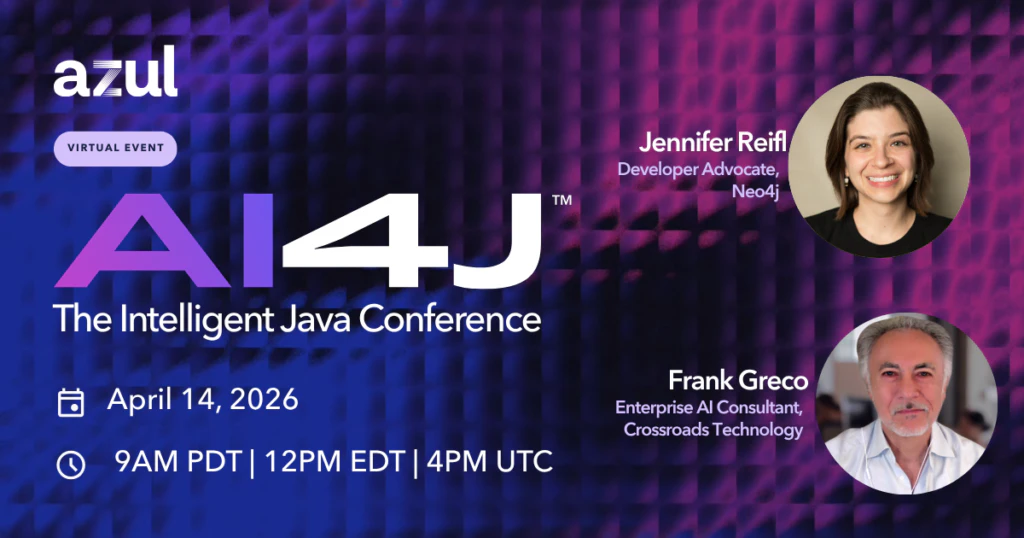
Simon, by the way, will be one of the presenters at AI4J, the Intelligent Java Conference, a virtual event on April 14th, starting at 9 a.m. PDT, which will feature nine of Java’s movers and shakers doing deep dives on the intersection of Java and enterprise AI. You don’t want to miss it. Register Now.
Java’s Role at Scale: The Control Plane for Enterprise AI
Here’s another stat from the Azul 2026 State of Java Survey & Report that’s even more telling:
31% of developers say that over half of the Java applications they’re building now include some form of AI.

AI applications introduce a fundamentally different model of computing. They are probabilistic, context-driven, and often non-deterministic. But enterprises don’t run on probabilities alone; they require reliability, security, observability, and integration with existing systems.
This is where Java excels. And the Java ecosystem is keeping pace with AI development. Libraries like JavaML and Deep Java Library (DJL) are maturing quickly to provide what enterprise developers are looking for:
- Long-term support for modern Java versions
- Built-in security
- Better observability
- Scalable data access
- Strong integration with large language models
Why This Matters for Java Teams
Rather than competing with Python, the real story here is that Java is becoming indispensable as AI moves into production. In fact, Java is operating as the control plane:
- Orchestrating models, APIs, and agents
- Managing transactions and workflows
- Enforcing governance and compliance
But this requires a shift in mindset. Development teams must now think in terms of:
- Systems, not features
- Context, not just code
- Guardrails, not just outputs
Because the hardest problem in AI is not building it – it’s making it reliable.
AI will continue to drive increased demand for compute resources of all kinds, including Java, because enterprises aren’t building AI systems from scratch. They’re layering AI capabilities onto existing Java applications where large datasets and user interactions already exist. And Java is likely to become increasingly critical to enterprise operations as the controlling language in an AI-driven world.
Where You Can Learn More
Learn more about the evolution of AI and Java at AI4J, The Intelligent Java Conference, on April 14th, starting at 9 a.m. PDT, and thereafter on-demand. Register Now.