


Introduction
Every security and compliance leader in a regulated industry knows the scenario. A critical CVE drops on a Friday afternoon. The advisory names a runtime the organization runs in production. The incident bridge opens, and the first question is not whether a patch exists but when it will reach the servers, whether it covers the version deployed there, and what evidence the team can produce for the auditor who, under PCI DSS, ISO 27001, or a comparable framework, will ask the same question in ninety days.
The patch itself is a technical problem, and most engineering teams can solve it given a build. The harder problem is structural. It is whether the runtime vendor’s patch model is designed so that the timeline to production is predictable, backported to the version in use, and documented before the CVE forces the question. On most incumbent application servers, it is not. The patch cycle is measured in weeks or months, the backport policy is unclear, and the evidence is assembled under pressure during the incident rather than produced from a schedule that already existed.
A predictable monthly patch cadence, backported across every supported version and shipped by a registered CVE Numbering Authority, is the control a regulated buyer is actually purchasing. It is the difference between an audit that produces a finding and an audit that produces a date range query.
The window between disclosure and weaponization
The first reason patch cadence matters more now than it did since even a year ago is that the window between a disclosure and a working exploit has collapsed. The standard framing is that attackers move at the speed of an AI prompt. Once a CVE is public, an LLM can draft an exploit outline against the advisory text within hours, and the bar for weaponizing a disclosed vulnerability is lower than it has ever been.
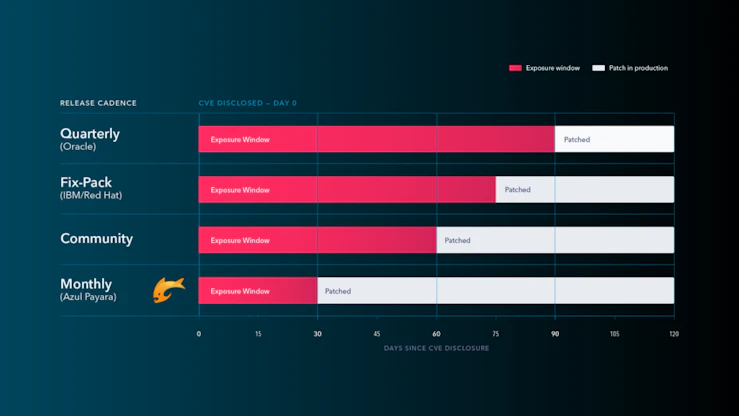
The implication for the runtime buyer is direct. The cost of a slow patch cycle is no longer measured in residual exposure over a few weeks. It is measured in the probability that a working exploit appears in the wild before the patch reaches production. A quarterly patch cycle, the model Oracle WebLogic runs on, means a critical CVE disclosed the week after a CPU ships can sit unresolved against production traffic for up to ninety days. A monthly cycle compresses that to thirty.
| Patch model | Cadence | Backport policy | What the auditor sees |
| Oracle WebLogic | Quarterly Critical Patch Update | Per-release; scope varies | A fixed quarterly date and gaps in between |
| IBM traditional WebSphere Application Server | Scheduled fix packs | Java EE 7 frozen; fix packs continue on IBM SDK Java 8 | A frozen specification and an older JDK |
| Red Hat JBoss EAP | Fix-pack cycle, weeks to months | Per major release | A cycle tied to the Red Hat product lifecycle |
| Community runtimes (GlassFish, WildFly, Tomcat) | When the community ships | No SLA; no backport guarantee | No vendor to call, no SLA to cite |
| Azul Payara | Monthly, on a published schedule | Backported to every supported version | A calendar the auditor can export |
The table reads as a technical comparison, but the last column is the one that matters to a CISO and a compliance lead: the evidence of patch posture an auditor actually assesses. A published monthly cadence with backporting is evidence that exists before the CVE lands. Patch-cadence sources: Oracle Security Alerts (quarterly CPU schedule); IBM WebSphere tWAS lifecycle and Java SE 8 in WAS traditional V9; Red Hat JBoss EAP update policy; Apache Tomcat security; Azul Payara lifecycle and July 2026 release notes.
What registered CNA actually means
The Azul Payara runtime is shipped by a registered CVE Numbering Authority under CISA and DHS oversight. A CVE Numbering Authority is an organization authorized to assign CVE identifiers to vulnerabilities it reports or discovers, with public registration, a defined scope, and disclosures that carry CVE IDs and CVSS scores. The status matters because it means the vendor is in the disclosure pipeline before the CVE is filed, ahead of the advisory rather than behind it.
CNA status is not unique to Azul; Oracle, IBM, and Red Hat are also registered CNAs. The differentiator is what the vendor does with that status. The two things that distinguish a cadence are whether it is published, and whether it backports.
| Claim | Accurate framing |
| Registered CVE Numbering Authority | True of Azul, and also of Oracle, IBM, and Red Hat. |
| Monthly published cadence | A published monthly schedule is predictable; a quarterly CPU or a fix-pack cycle is not. |
| Backported to every supported version | A patch that lands only on the latest version is not a patch for older versions in production. |
| Multi-phase support lifecycle per major release | Full, Extended, and Lifetime Support means the version in production stays in scope. |
IT should not look at status as a registered CNA in isolation but rather the combination of registered CNA status, a published monthly cadence, and backporting across every supported version. Any one of those without the others is a partial control.
The audit is a predictable schedule
A published cadence where IT is diligent about deploying the patch cadence is audit-defensible because it converts the audit from a project into a query, which is exactly what a PCI DSS, ISO 27001, or EU Cyber Resilience Act assessor asks for when examining the application-server layer. They want evidence that critical vulnerabilities were remediated within a defined window, and the dates to prove it.
Under many legacy app server vendor’s patch models, producing that evidence is a project. Someone trawls fix-pack logs, correlates them against the CVE advisories, reconstructs which version was running where on which date, and assembles a narrative. Under a published monthly cadence with backporting, the same evidence is a date range query against the release calendar. The assessor asks when CVE-XXXX was patched; the answer is the release date of the monthly stable release that carried the fix, for every supported version, as long as IT deploys the patch.
| Audit question | Incumbent-model answer | Published-cadence answer |
| When was this CVE patched in production? | Reconstructed from fix-pack logs and deployment records | The release date of the monthly stable that carried the fix |
| Is the patch on the version we run? | Depends on whether the version is still in the fix-pack scope | Yes; backported to every supported version |
| What is the patch SLA? | Undocumented or per-case | Standard, Extended and Lifetime support cycles. |
| What is the support lifecycle of the version in production? | Tied to the vendor’s product lifecycle, often behind a login | Multi-phase per major version, published on the vendor’s product support lifecycle page |
| Can you reproduce what ran in production? | Often no | Versioned enterprise Docker images reproduce exactly what ran |
The last row is the operational consequence of the structure above. Versioned enterprise container images, built and shipped by the vendor, mean the exact artifact that ran in production is reproducible. For a regulated audit, that closes the loop between the release calendar and the deployment record.
The Cyber Resilience Act makes this structural point sharper. The CRA entered into force in December 2024, with vulnerability and incident reporting obligations for software placed on the EU market taking effect September 11, 2026, and the broader conformity rules following in December 2027. A published monthly cadence with backporting is the evidence the regulation actually asks for at that deadline.
The one-patch-perimeter point
There is a second structural argument that applies specifically to the team adding AI to an existing Java application. The default AI integration pattern is a Python sidecar: a separate runtime, with its own dependency tree, its own CVE stream, and its own vulnerability-management program. That pattern doubles the patch perimeter. Two runtimes means two cadences to track, two backport policies to verify, and two sets of evidence to produce at audit.
On Jakarta EE 11, the AI libraries, LangChain4j, LangGraph4j, Koog, Jlama, run inside the JVM as managed dependencies. Their CVEs patch at the JVM level under the same monthly cadence as the rest of the runtime. One patch perimeter instead of two. For a CISO whose audit scope grows with every new runtime introduced, the difference is structural: the patch surface does not expand when AI arrives.
This is a Payara 7 capability, not a day-one claim for a Payara 5 or 6 target. The point here is when the app server modernization roadmap includes AI, the runtime decision should weigh the patch-perimeter consequence of the integration pattern, not only the inference quality of the model. Operating the Python sidecar is only part of the cost; patching and defending it is the rest.
What the proof looks like
The customer evidence for the cadence argument is specific.
Customers for whom patch cadence and audit defensibility are load-bearing concerns – telecom, federal, financial services – are the ones on the runtime. The cadence is the control they buy it for.
What to do this quarter
Three actions for different roles in your organization:
- For the CISO. Map your current application-server patch evidence process end to end. Most teams can already patch a CVE; the real question is how long it takes to produce the evidence an auditor needs after the patch lands. If that process is a project rather than a query, the patch model is where the gap actually lives. Ask your current vendor for their published patch cadence and their backport policy across the versions you run, in writing. A published monthly cadence is the control; anything less is a gap that an audit or a breach will find before a vendor roadmap fixes it.
- For the CIO or CTO. Run a parallel evaluation during your current renewal term. Deploy one standard Jakarta EE application to the namespace-matched Azul Payara version and track the next monthly security release against it. The technical question, does the application behave identically across a patch, answers itself in a month. The operational question, what does patch evidence look like under a published cadence, answers itself in the release calendar. The renewal deadline is the forcing function; the decision should rest on evidence pulled from your own environment.
- For the compliance lead. Read the patch-evidence clauses in PCI DSS, ISO 27001, and where relevant the Cyber Resilience Act and compare against your current application server vendor’s actual cadence. The gap between what the regulation asks for and what the incumbent’s patch cycle produces by default is the exposure. A published monthly cadence with backporting, from a registered CNA, with versioned container images, is the shape of the evidence those frameworks already describe. The compliance outcome is evidence that exists before the audit starts.
The team that ships the monthly cadence and the Azul Payara runtime works with federal, telecom, and financial services workloads where patch evidence is critical for audit compliance; contact Azul and we can walk through the release calendar, the backport policy, and the lifecycle against your specific regulatory scope.
The cadence is the control
A critical CVE on a Jakarta EE runtime is inevitable. The question is not whether one lands, but whether the runtime underneath is structured so the patch, the backport, and the evidence are already on the schedule before it does.
A quarterly patch cycle, a fix-pack cadence measured in weeks or months, or a community runtime with no SLA each leave a gap that a compliance audit measures and an attacker exploits. A monthly published cadence, backported to every supported version, from a registered CNA, turns the defense into a date range query. The release train is already scheduled, and the only open question is whether your runtime is on it.
Frequently Asked Questions
How often should a Jakarta EE application server be patched for security vulnerabilities?
The practical answer depends on the vendor’s release model, and those differ widely. Oracle WebLogic ships on a quarterly Critical Patch Update, so a vulnerability disclosed just after a CPU can wait up to ninety days for a scheduled fix. Red Hat JBoss EAP runs a fix-pack cycle measured in weeks to months, and community runtimes such as GlassFish, WildFly, and Tomcat ship when the community ships, with no SLA and no backport guarantee. Azul Payara Server publishes a monthly security release schedule, which compresses that worst-case window to roughly thirty days.
Do application server security patches cover older versions, or only the latest release?
This varies by vendor and is worth confirming in writing, because a patch that lands only on the newest release is not a patch for the version actually running in production. Oracle and Red Hat scope backports per release, so coverage depends on whether the deployed version is still inside the current fix-pack scope. Azul Payara Server backports security fixes to every supported version and runs a multi-phase support lifecycle — Full, Extended, and Lifetime Support — across concurrent major versions, so the version in production stays in scope.
What does it mean when a software vendor is a registered CVE Numbering Authority?
A CVE Numbering Authority is an organization authorized to assign CVE identifiers to vulnerabilities it discovers or receives reports about, operating with public registration, a defined scope, and disclosures that carry CVE IDs and CVSS scores. It means the vendor sits inside the disclosure pipeline before an advisory is published rather than reacting to it afterwards. The status on its own is not a differentiator: Oracle, IBM, Red Hat and Azul are all registered CNAs. What separates them is whether the vendor pairs that status with a published release cadence and backporting across every supported version.
What evidence do auditors ask for when reviewing application server patching?
Assessors working to PCI DSS, ISO 27001, or the EU Cyber Resilience Act want proof that critical vulnerabilities were remediated within a defined window, with dates to support it. Where the vendor’s patch model is irregular, producing that evidence means reconstructing a timeline from fix-pack logs and deployment records after the fact. Where the vendor publishes a fixed release schedule and backports across supported versions, as Azul Payara Server does, the same evidence becomes a date-range query against the release calendar — provided the patches were actually deployed. Versioned enterprise container images close the loop by making the exact artifact that ran in production reproducible.
Does adding AI features to a Java application increase the security patching burden?
It depends on the integration pattern. The common approach, running a Python sidecar alongside the Java application, introduces a second runtime with its own dependency tree, its own CVE stream, and its own vulnerability-management process — two cadences to track and two sets of audit evidence to produce. Running AI libraries such as LangChain4j, LangGraph4j, Koog, and Jlama inside the JVM on Jakarta EE 11 keeps them as managed dependencies, patched on the same schedule as the runtime itself, which is the model Azul Payara Server 7 supports. Azul publishes its Payara release calendar, backport policy, and support lifecycle, and will walk through them against a specific regulatory scope on request.


